
Repozytorium Uniwersytetu Zielonogórskiego udostępnia 9 860 obiektów cyfrowych
Obiekt
Tytuł: Redundancy-based intrusion tolerance approaches moving from classical fault tolerance methods
Współtwórca:
Yao, Baozhen - ed. ; Wang, Shuaian - ed. ; Asian, Sobhan - ed.
Podtytuł:
Tytuł publikacji grupowej:
Abstract:
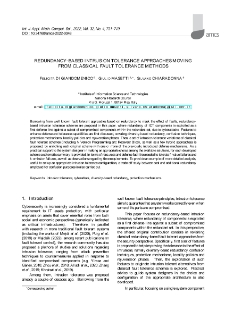
Borrowing from well known fault tolerant approaches based on redundancy to mask the effect of faults, redundancy-based intrusion tolerance schemes are proposed in this paper, where redundancy of ICT components is exploited as a first defense line against a subset of compromised components within the redundant set, due to cyberattacks. Features to enhance defense and tolerance capabilities are first discussed, covering diversity-based redundancy, confusion techniques, protection mechanisms, locality policies and rejuvenation phases. ; Then, a set of intrusion tolerance variations of classical fault tolerant schemes (including N Version Programming and Recovery Block, as well as a few hybrid approaches) is proposed, by enriching each original scheme with one or more of the previously introduced defense mechanisms. ; As a practical support to the system designer in making an appropriate choice among the available solutions, for each developed scheme a schematic summary is provided, in terms of resources and defense facilities needed to tolerate f value failures and k omission failures, as well as observations regarding time requirements. To provide an example of more detailed analysis, useful to set up an appropriate intrusion tolerance configuration, a trade-off study between cost and additional redundancy employed for confusion purposes is also carried out.
Wydawca:
Zielona Góra: Uniwersytet Zielonogórski
Identyfikator zasobu:
DOI:
Strony:
Źródło:
AMCS, volume 32, number 4 (2022) ; kliknij tutaj, żeby przejść
Jezyk:
Licencja CC BY 4.0:
Prawa do dysponowania publikacją:
Biblioteka Uniwersytetu Zielonogórskiego
Kolekcje, do których przypisany jest obiekt:
- Repozytorium > Jednostki organizacyjne > Wydział Informatyki, Elektrotechniki i Automatyki
- Repozytorium > Typy utworów > Artykuły
- Repozytorium > Czasopisma naukowe i serie wydawnicze UZ > International Journal of Applied Mathematics and Computer Science (AMCS) > International Journal of Applied Mathematics and Computer Science (AMCS) (2022)
Data ostatniej modyfikacji:
24 lip 2025
Data dodania obiektu:
24 lip 2025
Liczba wyświetleń treści obiektu:
74
Wszystkie dostępne wersje tego obiektu:
https://zbc.uz.zgora.pl/repozytorium/publication/101553
Wyświetl opis w formacie RDF:
Wyświetl opis w formacie OAI-PMH:
-
-
-
-
-
-
-
International Journal of Applied Mathematics and Computer Science (AMCS), volume 32, number 1 (2022)
-
International Journal of Applied Mathematics and Computer Science (AMCS), volume 32, number 2 (2022)
-
International Journal of Applied Mathematics and Computer Science (AMCS), volume 32, number 3 (2022)
-
International Journal of Applied Mathematics and Computer Science (AMCS), volume 32, number 4 (2022)
-
-
-
-
-
-
-
-
-
-
-
-
-
-
-
-
-
-
-
-
-
-
-
-
-
-
-
-
-
-
-
-
| Nazwa wydania | Data |
|---|---|
| Redundancy-based intrusion tolerance approaches moving from classical fault tolerance methods | 24 lip 2025 |
