
Repozytorium Uniwersytetu Zielonogórskiego udostępnia 9 867 obiektów cyfrowych
Obiekt
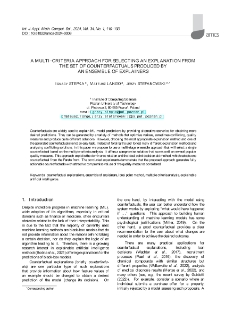
Tytuł: A multi-criteria approach for selecting an explanation from the set of counterfactuals produced by an ensemble of explainers
Współtwórca:
Korbicz, Józef (1951- ) - red. ; Uciński, Dariusz - red.
Tytuł publikacji grupowej:
Abstract:
Counterfactuals are widely used to explain ML model predictions by providing alternative scenarios for obtaining more desired predictions. They can be generated by a variety of methods that optimize various, sometimes conflicting, quality measures and produce quite different solutions. However, choosing the most appropriate explanation method and one of the generated counterfactuals is not an easy task. Instead of forcing the user to test many different explanation methods and analysing conflicting solutions, in this paper we propose to use a multi-stage ensemble approach that will select a single counterfactual based on the multiple-criteria analysis. ; It offers a compromise solution that scores well on several popular quality measures. This approach exploits the dominance relation and the ideal point decision aid method, which selects one counterfactual from the Pareto front. The conducted experiments demonstrate that the proposed approach generates fully actionable counterfactuals with attractive compromise values of the quality measures considered.
Wydawca:
Zielona Góra: Uniwersytet Zielonogórski
Identyfikator zasobu:
DOI:
Strony:
Źródło:
AMCS, volume 34, number 1 (2024) ; kliknij tutaj, żeby przejść
Jezyk:
Licencja CC BY 4.0:
Prawa do dysponowania publikacją:
Biblioteka Uniwersytetu Zielonogórskiego
Kolekcje, do których przypisany jest obiekt:
- Repozytorium > Jednostki organizacyjne > Wydział Informatyki, Elektrotechniki i Automatyki
- Repozytorium > Typy utworów > Artykuły
- Repozytorium > Czasopisma naukowe i serie wydawnicze UZ > International Journal of Applied Mathematics and Computer Science (AMCS) > International Journal of Applied Mathematics and Computer Science (AMCS) (2024)
Data ostatniej modyfikacji:
29 lip 2025
Data dodania obiektu:
29 lip 2025
Liczba wyświetleń treści obiektu:
147
Wszystkie dostępne wersje tego obiektu:
https://zbc.uz.zgora.pl/repozytorium/publication/101659
Wyświetl opis w formacie RDF:
Wyświetl opis w formacie OAI-PMH:
-
-
-
-
-
International Journal of Applied Mathematics and Computer Science (AMCS), volume 34, number 1 (2024)
-
International Journal of Applied Mathematics and Computer Science (AMCS), volume 34, number 2 (2024)
-
International Journal of Applied Mathematics and Computer Science (AMCS), volume 34, number 3 (2024)
-
International Journal of Applied Mathematics and Computer Science (AMCS), volume 34, number 4 (2024)
-
-
-
-
-
-
-
-
-
-
-
-
-
-
-
-
-
-
-
-
-
-
-
-
-
-
-
-
-
-
-
-
-
-
| Nazwa wydania | Data |
|---|---|
| A multi-criteria approach for selecting an explanation from the set of counterfactuals produced by an ensemble of explainers | 29 lip 2025 |
Obiekty Podobne
Janicka, Małgorzata Lango, Mateusz Stefanowski, Jerzy Clempner, Julio B. - ed. Ikonen, Enso - ed. Kurdyukov, Alexander P. - ed.
Wichrowski, Filip Ostrowski, Marcin Boratyn, Marta Kaczmarek-Majer, Katarzyna Korbicz, Józef (1951- ) - red. Uciński, Dariusz - red.
Stefanowski, Jerzy Krawiec, Krzysztof Wrembel, Robert Stefanowski, Jerzy - ed. Krawiec, Krzysztof - ed. Wrembel, Robert - ed.
