
Zielonogórska Biblioteka Cyfrowa udostępnia 67 657 obiektów cyfrowych
Obiekt
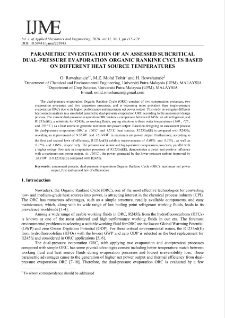
Tytuł: Parametric Investigation of an Assessed Subcritical Dual-Pressure Evaporation Organic Rankine Cycles Based on Different Heat Source Temperatures
Współtwórca:
Tytuł publikacji grupowej:
Abstract:
The dual-pressure evaporation Organic Rankine Cycle (ORC) consists of two compression processes, two evaporation processes, and two expansion processes, and is becoming more prevalent than single-pressure evaporation ORCs due to its higher performance and maximum net power output. This study investigates different heat sources analysis in a simulated parametric dual-pressure evaporation ORC according to the assessment design process. ; The current dual-pressure evaporation ORC makes a comparison between R245fa, an old refrigerant, and R1233zd(E), a substitute for R245fa, as working fluids, paying attention to three water temperatures (100, 125, and 150 [degrees]C) as a heat source to generate maximum net power output. Based on designing an assessment process for dual-pressure evaporation ORC at 100 [degrees]C and 125 °C heat sources, R1233zd(E) is compared with R245fa, revealing an improvement of 9.58 kW and 16.14 kW in maximum net power output. ; Furthermore, according to the first and second laws of efficiency, R1233zd(E) exhibits improvements of 0.09% and 0.56%, as well as 0.15% and 1.04%, respectively. The pressure rise in low and high-pressure compression processes, parallel with a higher exergy flow rate in evaporation processes of R1233zd(E), demonstrates a direct and positive influence with a maximum net power output. At 150 [degrees]C, the power generated by the lower-pressure turbine improved by 28.1 kW in R1233zd(E) compared with R245fa.
Wydawca:
Zielona Góra: Uniwersytet Zielonogórski
Format:
Identyfikator zasobu:
DOI:
Strony:
Źródło:
IJAME, volume 31, number 3 (2026)
Jezyk:
Licencja:
Licencja CC BY-NC-ND 4.0:
Prawa do dysponowania publikacją:
Biblioteka Uniwersytetu Zielonogórskiego
Kolekcje, do których przypisany jest obiekt:
- Zielonogórska Biblioteka Cyfrowa > Repozytorium > Jednostki organizacyjne > Wydział Mechaniczny
- Zielonogórska Biblioteka Cyfrowa > Repozytorium > Czasopisma naukowe i serie wydawnicze UZ > International Journal of Applied Mechanics and Engineering (IJAME)
- Zielonogórska Biblioteka Cyfrowa > Repozytorium > Czasopisma naukowe i serie wydawnicze UZ > Civil and Environmental Engineering Reports (CEER) > Civil and Environmental Engineering Reports (CEER) (2026)
Data ostatniej modyfikacji:
4 lis 2026
Data dodania obiektu:
4 lis 2026
Liczba wyświetleń treści obiektu:
0
Wszystkie dostępne wersje tego obiektu:
https://zbc.uz.zgora.pl/publication/115109
Wyświetl opis w formacie RDF:
Wyświetl opis w formacie OAI-PMH:
Obiekty Podobne
Yang, Fan Shah, Sirish L. Xiao, Deyun Korbicz, Józef (1951- ) - red. Uciński, Dariusz - red.
