
Digital Library of Zielona Góra contains 9 465 digital objects
Object
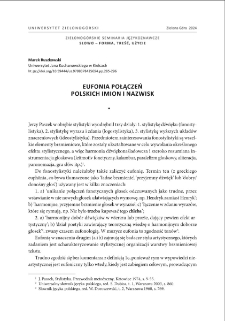
Title: Eufonia połączeń polskich imion i nazwisk = Euphony in Polish combination of first and last names
Contributor:
Hawrysz, Magdalena - red. nauk. ; Jurewicz-Nowak, Magdalena - red. nauk. ; Kotlarska, Irmina - red. nauk.
Group publication title:
Abstract_pl:
Przedmiotem rozważań jest w artykule eufonia interpretowana jako przyjemne brzmienie, unikanie połączeń głosek trudnych do wymówienia, zharmonizowanie strony dźwiękowej w połączeniach imion i nazwisk. Zestawienia imię - nazwisko mogą być tratowane jako fonetycznie harmonijne, ładnie brzmiące, eufoniczne albo jako brzmieniowo nieharmonijne, trudne artykulacyjnie czy wręcz kakofoniczne. ; Mimo że kryteria oceny eufonicznych walorów mowy są dość płynne, można przyjąć, iż w analizowanych połączeniach należałoby unikać: 1. rymów, 2. zestawiania obok siebie elementów, z których drugi (nazwisko) rozpoczyna się sylabą brzmiącą tak samo jak ostatnia sylaba wyrazu poprzedzającego (imienia), 3. łączenia imion i nazwisk brzmiących podobnie, 4. umieszczania obok siebie form zawierających w podobnych pozycjach te same głoski lub identyczne ich połączenia, 5. grup fonetycznych odczuwanych jako trudne do wymówienia lub niemile brzmiące. W praktyce od niektórych z wymienionych zasad odchodzi się z różnych względów. Do oceny stopnia eufoniczności zestawień imion i nazwisk można zastosować prawo językowe Behaghla. Mówi ono, że bardziej eufoniczne są połączenia dwóch elementów, z których pierwszy jest krótszy niż drugi (miarą długości jest liczba sylab).
Abstract:
The subject of analysis in the article is euphony perceived as a pleasant sound, as avoidance of combinations of sounds difficult to pronounce and harmonization of sounds in combinations of first and last names. First name - last surname combinations may be perceived as phonetically harmonious, nice-sounding, euphonic, or as inharmonious sounds, difficult to articulate, or even cacophonous. ; Although the criteria for evaluating the euphonic qualities of speech are quite different, it can be assumed that the following situations in the analyzed combinations should be avoided: 1. rhymes, 2. juxtaposing two elements, where the latter (surname) begins with a syllable sounding the same as the last syllable of the preceding word (first name), 3. combining first names and last names that sound similar, 4. putting next to each other forms containing the same sounds or identical combinations of them in similar positions, 5. creation of phonetic groups perceived as difficult to pronounce or having unpleasant sound. In practice, there are some an exception to the rule for various reasons. The Behaghel`s law can be used to assess the degree of euphony of first and last names. It says that combinations of two elements, where the first one is shorter than the second one (the measure of length is the number of syllables), are more euphonious.
Publisher:
Zielona Góra: Oficyna Wydawnicza Uniwersytetu Zielonogórskiego
Format:
Resource Identifier:
DOI:
Pages:
Source:
Zielonogórskie Seminaria Językoznawcze 2024
Language:
Rights:
Biblioteka Uniwersytetu Zielonogórskiego
Object collections:
- Repository > Faculties > Faculty of Humanities
- Repository > Types of work > Chapters in books
- Repository > Scientific journals and UZ publishing series > Zielonogórskie Seminaria Językoznawcze
Last modified:
Feb 20, 2026
In our library since:
Feb 20, 2026
Number of object content hits:
97
All available object's versions:
https://zbc.uz.zgora.pl/repozytorium/publication/104676
Show description in RDF format:
Show description in OAI-PMH format:
| Edition name | Date |
|---|---|
| Eufonia połączeń polskich imion i nazwisk = Euphony in Polish combination of first and last names | Feb 20, 2026 |
Objects Similar
Woźniak, Ewa Zarębski, Rafał Hawrysz, Magdalena - red. nauk. Uździcka, Marzanna - red. nauk.
Ilnicka, Daniela Sztyber, Radosław - red. nacz.
Ruszkowski, Marek Hawrysz, Magdalena - red. nauk. Uździcka, Marzanna - red. nauk.
Żuraszek-Ryś, Iwona Steciąg, Magdalena - red. nauk. Kaczor, Monika - red. nauk.
Dawidziak-Kładoczna, Małgorzata Sztyber, Radosław - red. nacz.
Jaklová, Alena Hawrysz, Magdalena - red. nauk. Uździcka, Marzanna - red. nauk.
