
Repozytorium Uniwersytetu Zielonogórskiego udostępnia 9 860 obiektów cyfrowych
Obiekt
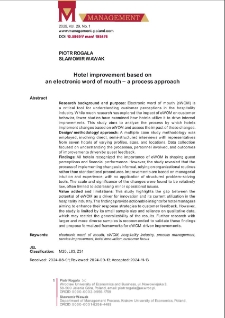
Tytuł: Hotel improvement based on an electronic word of mouth - a process approach
Współtwórca:
Stankiewicz, Janina - red. nacz. ; Preston, Peter- red. jęz. ; Zmyślony, Roman - red. statyst. ; Skalik, Jan - red. ; Moczulska, Marta - red. ; Adamczyk, Janusz- red.
Tytuł publikacji grupowej:
Abstract:
Research background and purpose: Electronic word of mouth (eWOM) is a critical tool for understanding customer perceptions in the hospitality industry. While much research has explored the impact of eWOM on customer behavior, fewer studies have examined how hotels utilize it to drive internal improvements. This study aims to analyze the process by which hotels implement changes based on eWOM and assess the impact of these changes. Design/methodology/approach: A multiple case study methodology was employed, involving direct, semi-structured interviews with representatives from seven hotels of varying profiles, sizes, and locations. Data collection focused on understanding the processes, personnel involved, and outcomes of improvements driven by guest feedback. ; Findings: All hotels recognized the importance of eWOM in shaping guest perceptions and financial performance. However, the study revealed that the process of implementing changes is informal, relying on organizational routines rather than standardized procedures. Improvements are based on managerial intuition and experience, with no application of structured problem-solving tools. The scale and significance of the changes were found to be relatively low, often limited to addressing minor operational issues. ; Value added and limitations: This study highlights the gap between the potential of eWOM as a driver for innovation and its current utilization in the hospitality industry. The findings provide actionable insights for hotel managers aiming to enhance their response strategies to customer feedback. However, the study is limited by its small sample size and reliance on qualitative data, which may restrict the generalizability of the results. Further research with larger and more diverse samples is recommended to validate these findings and propose formalized frameworks for eWOM-driven improvements.
Wydawca:
Zielona Góra: Faculty of Economics and Management Press
Format:
Identyfikator zasobu:
DOI:
Strony:
Źródło:
Management, vol. 29, no 1 (2025)
Jezyk:
Prawa do dysponowania publikacją:
Biblioteka Uniwersytetu Zielonogórskiego
Kolekcje, do których przypisany jest obiekt:
- Repozytorium > Jednostki organizacyjne > Wydział Ekonomii i Zarządzania
- Repozytorium > Typy utworów > Artykuły
- Repozytorium > Czasopisma naukowe i serie wydawnicze UZ > Management > Management, volumen 29 (2025)
Data ostatniej modyfikacji:
20 sie 2026
Data dodania obiektu:
13 sie 2026
Liczba wyświetleń treści obiektu:
134
Wszystkie dostępne wersje tego obiektu:
https://zbc.uz.zgora.pl/repozytorium/publication/109890
Wyświetl opis w formacie RDF:
Wyświetl opis w formacie OAI-PMH:
| Nazwa wydania | Data |
|---|---|
| Hotel improvement based on an electronic word of mouth - a process approach | 20 sie 2026 |
Obiekty Podobne
Nguyen, Thuc Ngoc Stankiewicz, Janina - red. nacz. Preston, Peter- red. jęz. Zmyślony, Roman - red. statyst. Skalik, Jan - red. Moczulska, Marta - red. Adamczyk, Janusz- red.
Thao Nguyen Thi Phuong Anh Nguyen Van Stankiewicz, Janina - red. nacz. Preston, Peter- red. jęz. Zmyślony, Roman - red. statyst. Skalik, Jan - red. Moczulska, Marta - red. Adamczyk, Janusz- red.
Shili, Aicha Toukabri, Maher Stankiewicz, Janina - red. nacz. Preston, Peter- red. jęz. Zmyślony, Roman - red. statyst. Skalik, Jan - red. Moczulska, Marta - red. Adamczyk, Janusz- red.
Khan, Muhammad Younas Faiz, Shazia Safdar, Samyia Stankiewicz, Janina - red. nacz. Preston, Peter- red. jęz. Zmyślony, Roman - red. statyst. Skalik, Jan - red. Moczulska, Marta - red. Adamczyk, Janusz- red.
Brajer-Marczak, Renata Moczulska, Marta - red. Preston, Peter- red. jęz. Stankiewicz, Janina - red. nacz. Zmyślony, Roman - red. statyst. Adamczyk, Janusz- red. Skalik, Jan - red.
Krzakiewicz, Kazimierz Cyfert, Szymon Moczulska, Marta - red. Preston, Peter- red. jęz. Stankiewicz, Janina - red. nacz. Zmyślony, Roman - red. statyst. Adamczyk, Janusz- red. Skalik, Jan - red.
Nguyen, Hang Thi Stankiewicz, Janina - red. nacz. Preston, Peter- red. jęz. Zmyślony, Roman - red. statyst. Skalik, Jan - red. Moczulska, Marta - red. Adamczyk, Janusz- red.
