
Zielonogórska Biblioteka Cyfrowa udostępnia 67 626 obiektów cyfrowych
Obiekt
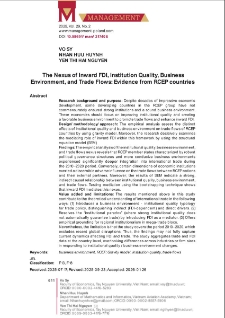
Tytuł: The Nexus of Inward FDI, Institution Quality, Business Environment, and Trade Flows: Evidence from RCEP countries
Współtwórca:
Stankiewicz, Janina - red. nacz. ; Preston, Peter- red. jęz. ; Zmyślony, Roman - red. statyst. ; Skalik, Jan - red. ; Moczulska, Marta - red. ; Adamczyk, Janusz- red.
Tytuł publikacji grupowej:
Abstract:
Research background and purpose: Despite decades of impressive economic development, some developing countries in the RCEP group have not commensurately ensured strong institutions and a sound business environment. These economies should focus on improving institutional quality and creating a favorable business environment to promote trade flows and enhance inward FDI. ; Design/methodology/approach: The empirical analysis assess the distinct effects of institutional quality and business environment on trade flows of RCEP countries by using gravity model. Moreover, the research decisively examines the mediating role of inward FDI within this framework by using the structural equation model (SEM) ; Findings: The empirical analysis of the institutional quality, business environment, and trade flows nexus reveals that RCEP member states characterized by robust political governance structures and more conducive business environments experienced significantly deeper integration into international trade during the 2010-2020 period. ; Conversely, certain dimensions of economic institutions exerted a discernible adverse influence on the trade flows between RCEP nations and their external partners. Moreover, the results of SEM indicate a strong, indirect causal relationship between institutional quality, business environment, and trade flows. Testing mediation using the bootstrapping technique shows that inward FDI mediates this nexus. ; Value added and limitations: The results mentioned above in this study contribute to the theoretical understanding of international trade in the following ways: (1) Introduces a business environment - institutional quality typology for trade policy, distinguishing indirect (FDI-dependent) and direct drivers. (2) Resolves the "institutional paradox" by introducing FDI as a mediator. (3) Offers empirical grounding for regional institutionalism in mega-trade blocs. ; Nevertheless, the limitation is that the study covers the period 2010-2020, which excludes recent global disruptions. Thus, the findings may not fully capture current dynamics affecting FDI and trade. The study aggregates trade and FDI data at the country level, overlooking differences across industries or firm sizes in responding to institutional quality /business environment changes.
Wydawca:
Zielona Góra: Faculty of Economics and Management Press
Format:
Identyfikator zasobu:
DOI:
Strony:
Źródło:
Management, vol. 29, no 2 (2025)
Jezyk:
Prawa do dysponowania publikacją:
Biblioteka Uniwersytetu Zielonogórskiego
Kolekcje, do których przypisany jest obiekt:
- Zielonogórska Biblioteka Cyfrowa > Repozytorium > Jednostki organizacyjne > Wydział Ekonomii i Zarządzania
- Zielonogórska Biblioteka Cyfrowa > Repozytorium > Typy utworów > Artykuły
- Zielonogórska Biblioteka Cyfrowa > Repozytorium > Czasopisma naukowe i serie wydawnicze UZ > Management
- Zielonogórska Biblioteka Cyfrowa > Repozytorium > Czasopisma naukowe i serie wydawnicze UZ > Management > Management, volumen 29 (2025)
Data ostatniej modyfikacji:
20 sie 2026
Data dodania obiektu:
20 sie 2026
Liczba wyświetleń treści obiektu:
100
Wszystkie dostępne wersje tego obiektu:
https://zbc.uz.zgora.pl/publication/110057
Wyświetl opis w formacie RDF:
Wyświetl opis w formacie OAI-PMH:
| Nazwa wydania | Data |
|---|---|
| The Nexus of Inward FDI, Institution Quality, Business Environment, and Trade Flows: Evidence from RCEP countries | 20 sie 2026 |
Obiekty Podobne
Nga Le Thi Viet Huy Dinh Tran Ngoc Hang Nga Nguyen Thi Lan Leng Thi Thach Nguyen Ngoc Stankiewicz, Janina - red. nacz. Preston, Peter- red. jęz. Zmyślony, Roman - red. statyst. Skalik, Jan - red. Moczulska, Marta - red. Adamczyk, Janusz- red.
Bui, Hang Thi Thu Nguyen, Yen Thi Hai Stankiewicz, Janina - red. nacz. Preston, Peter- red. jęz. Zmyślony, Roman - red. statyst. Skalik, Jan - red. Moczulska, Marta - red. Adamczyk, Janusz- red.
Bielski, Ireneusz Moczulska, Marta - red. Preston, Peter- red. jęz. Stankiewicz, Janina - red. nacz. Zmyślony, Roman - red. statyst. Adamczyk, Janusz- red. Skalik, Jan - red.
