
Zielonogórska Biblioteka Cyfrowa udostępnia 67 626 obiektów cyfrowych
Obiekt
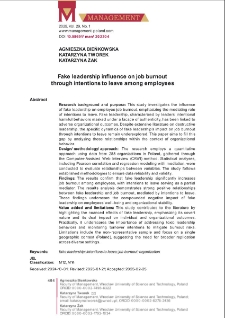
Tytuł: Fake leadership influence on job burnout through intentions to leave among employees
Współtwórca:
Stankiewicz, Janina - red. nacz. ; Preston, Peter- red. jęz. ; Zmyślony, Roman - red. statyst. ; Skalik, Jan - red. ; Moczulska, Marta - red. ; Adamczyk, Janusz- red.
Tytuł publikacji grupowej:
Abstract:
Research Background and Purpose: This study investigates the influence of fake leadership on employee job burnout, emphasizing the mediating role of intentions to leave. Fake leadership, characterized by leaders` intentional harmful behaviors masked under a facade of authenticity, has been linked to adverse organizational outcomes. Despite extensive literature on destructive leadership, the specific dynamics of fake leadership`s impact on job burnout through intentions to leave remain underexplored. This paper aims to fill this gap by analyzing these relationships within the context of organizational behavior. ; Design/Methodology/Approach: The research employs a quantitative approach using data from 285 organizations in Poland, gathered through the Computer-Assisted Web Interview (CAWI) method. Statistical analyses, including Pearson correlation and regression modeling with mediation, were conducted to evaluate relationships between variables. The study follows established methodologies to ensure data reliability and validity. ; Findings: The results confirm that fake leadership significantly increases job burnout among employees, with intentions to leave serving as a partial mediator. The results analysis demonstrates strong positive relationships between fake leadership and job burnout, mediated by intentions to leave. These findings underscore the compounded negative impact of fake leadership on employees` well-being and organizational stability. ; Value Added and Limitations: This study contributes to the literature by highlighting the nuanced effects of fake leadership, emphasizing its covert nature and its dual impact on individual and organizational outcomes. Practically, it underscores the importance of addressing toxic leadership behaviors and monitoring turnover intentions to mitigate burnout risks. Limitations include the non-representative sample and focus on a single geographic context (Poland), suggesting the need for broader replication across diverse settings.
Wydawca:
Zielona Góra: Faculty of Economics and Management Press
Format:
Identyfikator zasobu:
DOI:
Strony:
Źródło:
Management, vol. 29, no 1 (2025)
Jezyk:
Prawa do dysponowania publikacją:
Biblioteka Uniwersytetu Zielonogórskiego
Kolekcje, do których przypisany jest obiekt:
- Zielonogórska Biblioteka Cyfrowa > Repozytorium > Jednostki organizacyjne > Wydział Ekonomii i Zarządzania
- Zielonogórska Biblioteka Cyfrowa > Repozytorium > Typy utworów > Artykuły
- Zielonogórska Biblioteka Cyfrowa > Repozytorium > Czasopisma naukowe i serie wydawnicze UZ > Management > Management, volumen 29 (2025)
Data ostatniej modyfikacji:
17 sie 2026
Data dodania obiektu:
17 sie 2026
Liczba wyświetleń treści obiektu:
68
Wszystkie dostępne wersje tego obiektu:
https://zbc.uz.zgora.pl/publication/109918
Wyświetl opis w formacie RDF:
Wyświetl opis w formacie OAI-PMH:
| Nazwa wydania | Data |
|---|---|
| Fake leadership influence on job burnout through intentions to leave among employees | 17 sie 2026 |
Obiekty Podobne
Bieńkowska, Agnieszka Zabłocka-Kluczka, Anna Moczulska, Marta - red. Preston, Peter- red. jęz. Stankiewicz, Janina - red. nacz. Zmyślony, Roman - red. statyst. Adamczyk, Janusz- red. Skalik, Jan - red.
Bieńkowska, Agnieszka Tworek, Katarzyna Sałamacha, Anna Stankiewicz, Janina - red. nacz. Preston, Peter- red. jęz. Zmyślony, Roman - red. statyst. Skalik, Jan - red. Moczulska, Marta - red. Adamczyk, Janusz- red.
Bieńkowska, Agnieszka Tworek, Katarzyna Zabłocka-Kluczka, Anna Stankiewicz, Janina - red. nacz. Preston, Peter- red. jęz. Zmyślony, Roman - red. statyst. Skalik, Jan - red. Moczulska, Marta - red. Adamczyk, Janusz- red.
Bieńkowska, Agnieszka Kral, Zygmunt Zabłocka-Kluczka, Anna Skalik, Jan - red. Moczulska, Marta - red. Preston, Peter- red. jęz. Stankiewicz, Janina - red. nacz. Zmyślony, Roman - red. statyst. Adamczyk, Janusz- red.
Bortnowska, Hanna Seiler, Bartosz Moczulska, Marta - red. Preston, Peter- red. jęz. Stankiewicz, Janina - red. nacz. Zmyślony, Roman - red. statyst. Adamczyk, Janusz- red. Skalik, Jan - red.
Stankiewicz, Janina Seiler, Bartosz Moczulska, Marta - red. Preston, Peter- red. jęz. Stankiewicz, Janina - red. nacz. Zmyślony, Roman - red. statyst. Adamczyk, Janusz- red. Skalik, Jan - red.
Bieńkowska, Agnieszka Zabłocka-Kluczka, Anna Moczulska, Marta - red. Preston, Peter- red. jęz. Stankiewicz, Janina - red. nacz. Zmyślony, Roman - red. statyst. Adamczyk, Janusz- red. Skalik, Jan - red.
Góralewska-Słońska, Anna Maria Moczulska, Marta - red. Preston, Peter- red. jęz. Stankiewicz, Janina - red. nacz. Zmyślony, Roman - red. statyst. Adamczyk, Janusz- red. Skalik, Jan - red.
